
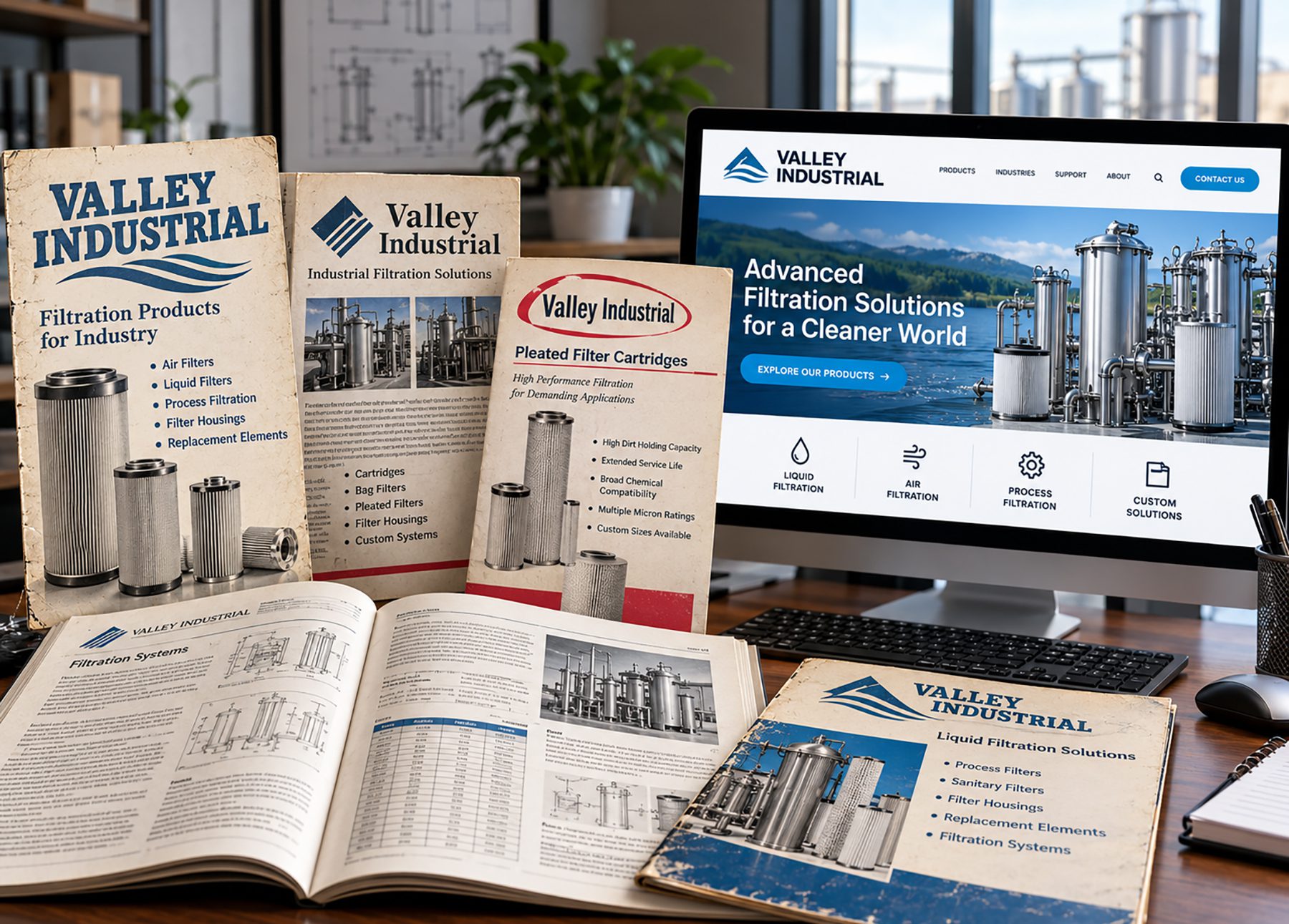
Somewhere in almost every industrial company, there’s a box of brochures that was printed years ago. There’s a spec sheet with an old phone number on it, a line card listing a product you discontinued, and a sales presentation your team has been reusing since before the last trade show.
Nobody decided to let them get outdated. Everyone was simply busy making, selling and shipping products. But here’s the question worth asking: Are your sales materials still helping you win business, or are they quietly working against you?
Your Materials Speak When You’re Not in the Room
Because your salesperson can’t be everywhere, answering every technical question the moment a prospect raises it, your sales materials are an extremely valuable asset in your arsenal. An engineer downloads your data sheet and forwards it to purchasing. A plant manager pulls your brochure out of a folder six months after a trade show. A distributor hands your line card to a customer you’ve never met. A capabilities PDF gets passed around a meeting where the shortlist is being decided.
In every one of those moments, your sales materials are doing the talking. They have to make your case on their own, without anyone there to explain them.
That makes them some of the hardest-working marketing pieces you have, and often the most neglected.
What Counts as “Sales Materials” Today?
The term covers more than the printed brochure. For most industrial companies, it includes:
- Capabilities and product brochures
- Spec sheets and data sheets
- Line cards
- Application guides and case studies
- Sales presentations
- Quote and proposal templates
- Trade show handouts
- Distributor and rep kits
And today, most of these live primarily as digital files: downloaded from your website, attached to emails, forwarded between colleagues and opened on phones. A piece that only looks good printed on glossy paper may not be doing its job at all.
7 Signs Your Materials Have Fallen Behind
How do you know when it’s time for an update? Here are the top common warning signs:
- The information is outdated. Discontinued products, missing new ones, old certifications, former employees’ names, an old address are prime examples.
- They don’t match your website or brand. This is a big one. If your brochure and your website look like they came from two different companies, prospects notice — and it’s not a positive impression. Outdated logo iterations on older materials, dated-looking materials when you are trying to convey that you are at the forefront of technology in your industry…these can harm more than they help.
- They talk about you, not the customer. “Founded in 1972, we are a leading manufacturer of…” says little about the problem the reader needs solved. Pieces that assure customers that you understand their problems, and can help solve them, become tremendous sales assets.
- They list features without applications. Engineers want to know where and how your product is used, and what it does better. Application notes and case studies can establish a common reality with the customer and greatly assist the sale.
- They don’t work digitally. The files are too big to email, hard to read on a phone, or full of links that go nowhere. Example: a 4-page 8.5x 11 brochure is saved as PDF spreads, instead of being split up into 4 8.5×11 pages for emailing.
- There’s no clear next step. The reader finishes the page and has no idea what to do next. Especially i digital materials, which could be made with clickable call and website links, this is a big missed opportunity.
- Your salespeople have stopped using them — or have made their own versions. Usually if this happens, it’s followed by Number 2 above.
If more than one or two of these sound familiar, your materials are likely costing you opportunities you’ll never see.
The “Rogue Materials” Problem
That last warning sign (#7) deserves a closer look. When official sales materials don’t meet the sales team’s needs, salespeople do what resourceful people do: they make their own.
A Word document here. A modified PowerPoint there. A rep’s own version of your spec sheet with handwritten corrections. Before long there are a dozen versions of your company’s story in circulation, with different specs, different messages and different logos.
Rogue materials aren’t a discipline problem. They’re a signal. Your salespeople are telling you what the official pieces are missing. Ask them. They know exactly what information customers consistently ask for.
Write for the Whole Buying Group
Industrial purchases rarely involve just one person. The engineer cares about specifications, tolerances and performance. Purchasing wants part numbers, lead times and certifications. Management is thinking about reliability, total cost and risk.
Good sales materials are built in layers so each reader can find what matters to them quickly:
- A clear headline stating the benefit or problem solved
- Scannable specifications and technical data
- Real applications showing where the product is used
- Proof: certifications, case studies, customer results
- A clear next step
When the messaging is grounded in what makes your company different, every piece reinforces the same story. (We discussed this in The Power of Positioning in Industrial Marketing.)
Design Is Part of the Message
Technical buyers judge more than the words. A cluttered, inconsistent or poorly laid out spec sheet can suggest the same carelessness about engineering, fair or not. Clean layouts, logical hierarchy, clear technical diagrams and real application photography make complex information easier to absorb. They also signal professionalism and precision before the reader has processed a single specification.
A consistent template system brings another benefit: when you launch a new product, adding its data sheet becomes quick and easy, and it automatically looks like part of the family. Consistency across your materials, website and advertising is a big part of what builds brand recognition. (More on that in Why Branding Matters in Industrial Marketing.)
Built for How Materials Are Used Today
Because most sales materials now live digitally, a few practical details make a big difference:
- File sizes small enough to email without bouncing
- Live links to CAD downloads, detailed specs, videos and contact pages
- Readable on a phone, where many first looks now happen
- One current version on your website, so anyone who forwards a link always gets the latest information
- QR codes on printed pieces and trade show handouts that lead to updated online resources
These small things keep your materials working long after they leave your hands.
Sales Materials Support the Entire Buying Journey
Different materials do different jobs at different stages:
- Early on: A capabilities brochure or overview introduces your company.
- During research: Application guides, case studies and technical articles build credibility.
- At decision time: Spec sheets, comparison guides and well-designed proposals help close the deal.
- After the sale: Installation guides and support materials reinforce that the customer made the right choice.
They’re also essential in lead nurturing. When someone downloads a white paper or requests information, what you send next matters. A relevant case study or application guide keeps the conversation going. (See Lead Nurturing in Industrial Marketing.)
Steps for a Quick Materials Audit
You don’t need a major project to find out where you stand. Try this:
- Gather everything, including your reps’ and salespeople’s own versions.
- Check for accuracy: products, specs, certifications, contacts.
- Lay them out next to your website. Do they look and sound like the same company?
- Ask salespeople or a rep what they actually use, what they don’t, and what customers keep asking for.
- For each piece, ask: What do we want the reader to do next, and does this piece make that clear?
The answers will quickly show you what needs a refresh, what needs a rewrite and what’s missing altogether.
Give Your Sales Team Something Worth Handing Over
Your sales materials are often the most tangible representation of your company a prospect will ever hold. They should look as capable as your engineering and support the conversations your salespeople are trying to have.
At ClearImages, we’ve spent years designing and writing sales materials for manufacturers and industrial companies: brochures, data sheets, line cards, case studies, presentations, trade show pieces and template systems. We make sure they’re technically accurate, consistent with your brand and website, and built for how engineers and buyers actually use them today. The goal is simple: materials your sales team is proud to hand over, and that keep selling after they do. Pull out your most recent brochure and hand it to someone who has never heard of your company. Could they tell within 30 seconds what you do, who you help and why you’re different? If not, let’s talk.