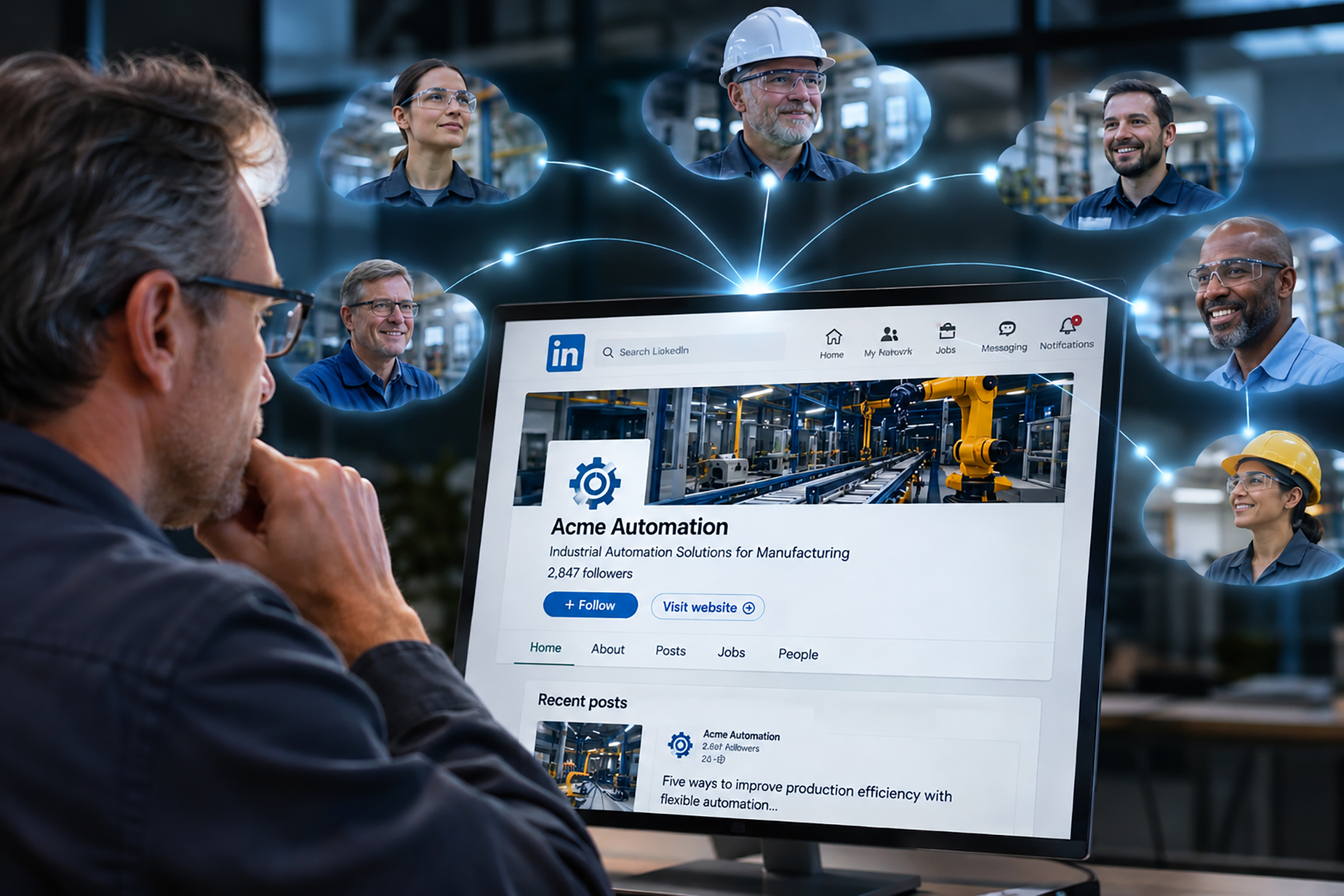
Why LinkedIn deserves a place in your industrial marketing strategy—and how to use it effectively without turning social networking into a sales pitch.
For manufacturers and industrial companies, marketing has traditionally focused on trade publications, industry directories, advertising, trade shows, and direct relationships with customers. These channels remain vitally important, particularly when selling complex products that require technical evaluation and involve lengthy purchasing cycles. But there’s another channel that deserves consideration and a place in the mix: LinkedIn.
While many manufacturers maintain a Facebook presence, LinkedIn is generally the more strategically relevant social networking platform for business-to-business marketing. Its emphasis on professional relationships, industry expertise, and business connections makes it particularly useful for reaching engineers, purchasing managers, plant managers, executives, and others involved in industrial buying decisions.
However, LinkedIn works differently from most traditional marketing channels. Its greatest value isn’t necessarily generating an immediate inquiry or RFQ. It’s helping people become familiar with your company, recognize your expertise, and develop the confidence that can eventually lead to a business relationship. Understanding that distinction is the key to using LinkedIn effectively.
Why LinkedIn Makes Sense for Industrial Marketing
The fundamental advantage of LinkedIn is its professional orientation. People generally use Facebook to connect with friends and family, while LinkedIn is a place to maintain professional relationships, follow companies, learn about industry developments, and establish business connections. For manufacturers, this distinction is significant.
A company selling precision components, industrial equipment, automation systems, or specialized manufacturing services isn’t necessarily trying to reach thousands of consumers. It may need to reach a relatively small audience of qualified individuals working in specific industries or holding particular responsibilities. LinkedIn makes those individuals more accessible. A manufacturer can identify people by their job titles, employers, industries, and professional backgrounds. It can follow organizations operating in its target markets, participate in relevant discussions, and share technical information with people who may have a professional interest in its products or capabilities.
Research supports LinkedIn’s relevance to technical audiences. The 2026 State of Marketing to Engineers report from GlobalSpec and TREW Marketing, conducted in collaboration with Elektor, found that 53% of surveyed technical buyers considered LinkedIn somewhat or very valuable when seeking information for work. That’s meaningful in that It suggests that industrial marketers should view LinkedIn as part of a broader information ecosystem. LinkedIn’s particular strength is its ability to connect technical content with identifiable professionals, companies, and industry conversations.
LinkedIn Is About Relationships, Not Just Leads
One of the most common mistakes companies make with LinkedIn is approaching it as though it were simply another direct advertising channel. They establish a company page, post announcements about their products, and perhaps send connection requests to prospective customers. Then they wonder why those activities aren’t producing immediate sales. The problem is often one of expectations.
LinkedIn is, first and foremost, social media. Of all the marketing techniques available to industrial companies, organic social networking is among the lightest-touch approaches. Its purpose is to establish familiarity, encourage conversation, and gradually develop trust.
Consider an engineer evaluating suppliers for a new automation project. That engineer may encounter a useful technical article shared by a manufacturer’s engineering manager. Several weeks later, the same individual might see an informative comment from that engineer in an industry discussion. Eventually, when a project requires a product or capability that manufacturer offers, the company’s name is already familiar. No single interaction necessarily created a sales lead. But the cumulative effect helped establish credibility.
This is particularly relevant in industrial markets, where buying decisions can take months or even years and frequently involve multiple people. The 2026 GlobalSpec/TREW research found that approximately 62% of the technical buying process takes place online before buyers engage with sales. That makes the information and professional credibility buyers encounter during their independent research especially important. The objective should not be to turn every LinkedIn connection into a prospect. It should be to become a recognizable, credible resource within the industries your company serves.
Company Pages vs. Individual Profiles: Why Manufacturers Need Both
LinkedIn provides two distinct ways to establish a presence: the company page and individual employee profiles. They serve different purposes, and a strong LinkedIn strategy should make use of both.
Your Company Page: Establishing a Credible Business Presence
Your company’s LinkedIn page functions as an extension of its professional identity. It provides a place where people can learn about the organization, its products and services, industries served, employees, and recent activities. A well-maintained company page can reinforce the credibility established through your website and other marketing materials. It also creates another way for people to discover your company. LinkedIn users can search for organizations by name and browse company-related results, while search engines may index public company pages. Although a LinkedIn page should never replace a well-designed corporate website, it provides another opportunity to be found and evaluated.
For manufacturers, a company page should clearly communicate what the organization does, which industries it serves, and the technical capabilities that distinguish it. The content shared there might include new product developments, application examples, engineering articles, case studies, videos, company news, or links to useful technical resources. A company page also provides a central location where employees, customers, suppliers, and other interested professionals can follow your organization’s activity.
But there’s a limitation: a company page is a corporate voice. And business relationships are often built more naturally between people.
Individual Profiles: Putting People Behind the Company
An individual LinkedIn profile represents a person rather than an organization. That distinction can be especially valuable in industrial markets, where technical knowledge, experience, and professional reputation influence purchasing decisions.
Consider the potential impact of an experienced engineering manager who regularly shares practical insights about manufacturing challenges, or a company president who contributes thoughtful observations about industry developments. These individuals are not simply promoting their employer. They are demonstrating the knowledge and experience that exist within the organization.
Individual profiles are also useful for networking and discovery. LinkedIn members can search for people by name, title, company, and other professional criteria, subject to the platform’s search and account limitations. They can connect with individuals, follow their public activity, and develop professional relationships over time. A company page cannot replace that personal dimension.
For smaller manufacturers, particularly those whose owners and senior executives have deep industry experience, this can be a substantial advantage. The people who built and manage the company often possess exactly the expertise that prospective customers value. Encouraging those individuals to maintain complete, professional LinkedIn profiles—and occasionally share meaningful insights—can extend the company’s visibility and credibility beyond its corporate page.
The best approach isn’t to have every employee repost identical promotional messages. It’s to encourage authentic participation from people who have something useful to contribute.
Growing Your Company Page: Why Followers Matter
Once a manufacturer has established its LinkedIn company page, the next question is how to attract followers—and whether the effort is worthwhile.
A follower is someone who has expressed an interest in receiving updates from your organization. That doesn’t make the person a sales lead, but it does create an opportunity for continued communication. Each time your company publishes useful content, some of those followers may encounter it in their feeds, depending on LinkedIn’s distribution algorithms and their activity. They may read an article, watch a product demonstration, share information with a colleague, or simply become more familiar with your company. Over time, that familiarity can become valuable.
The goal shouldn’t necessarily be to accumulate the largest possible number of followers. A manufacturer with 500 followers who work in its target industries may have a more valuable audience than a company with 5,000 followers who have little professional interest in its products. Building a relevant following can begin with existing relationships. Employees can invite professional connections to follow the company page, and companies can encourage customers, distributors, suppliers, and industry associates to do the same. The overall goal is to have an engaged following. Inviting and connecting with relevant people will mean actual conversations can ensue.
LinkedIn provides page administrators with invitation tools, including monthly invitation credits. Its Premium Company Page offering adds certain expanded invitation capabilities, such as inviting followers of similar pages and automatically inviting people who have engaged with company content. Employees can also help extend the company’s reach. LinkedIn allows page administrators to notify employees about important company posts, giving them an opportunity to engage with or share the information when it is relevant to their own professional networks.
Of course, attracting followers is only half the equation. The company must consistently give those followers a reason to remain interested. A steady stream of product promotions will eventually become easy to ignore. Useful information about industry challenges, manufacturing processes, technical applications, and engineering solutions is far more likely to encourage meaningful engagement.
LinkedIn Groups: An Opportunity to Reach Your Target Industries
One of LinkedIn’s potentially valuable but often underutilized features is its professional groups.Groups bring together people with common interests, professional responsibilities, or industry affiliations. For manufacturers, they can provide opportunities to participate in discussions that are directly related to the markets they want to reach.
For example, a company manufacturing motion control components might look for groups focused on industrial automation, robotics, mechanical engineering, or machine design. A supplier of filtration equipment might seek out communities focused on water treatment, process engineering, food processing, or industrial maintenance. The advantage is relevance. Rather than broadcasting a message to a broad audience and hoping it reaches the right people, a manufacturer can participate in discussions among professionals who already share an interest in a particular subject.
But there is an important distinction between joining a group and using it effectively.
Contribute Expertise, Not Sales Pitches
The best way to establish credibility within a LinkedIn group is to provide information that members genuinely find useful.
An engineer might contribute an explanation of how a particular design approach addresses a common manufacturing problem. A company executive might offer insight into changes affecting an industry. A technical sales representative might answer a question about material selection, performance considerations, or application requirements. Occasionally, a relevant technical article, case study, or educational resource may also be appropriate to share, provided it complies with the group’s rules. The emphasis should be on helping the group, not selling to it.
LinkedIn itself advises group members to focus on conversations and relationships rather than promotion. Its guidance warns against commercial links intended primarily to sell products and against posting identical content across multiple groups.
That reinforces an important principle: The quickest way to undermine credibility in a professional group is to treat its members as a prospect list.
Manufacturers should also evaluate groups before investing substantial time in them. Some groups have thousands of members but very little meaningful activity. Others are dominated by promotional posts. A smaller, well-moderated group with active technical discussions may offer considerably more value. The objective is to become a respected participant in the professional conversation.
What Should Manufacturers Post on LinkedIn?
Industrial companies sometimes struggle with social media because they believe they don’t have anything interesting to share. In reality, most manufacturers have an abundance of useful information. Much of it already exists within their engineering departments, technical literature, sales presentations, product documentation, and customer application experience. The challenge is recognizing that information as content worth sharing.
A technical article explaining how to solve a common application problem may be far more interesting to an engineer than an announcement about a new product. A short video demonstrating a manufacturing process can communicate capabilities more effectively than a paragraph of promotional claims. A case study describing how a customer overcame a design challenge can help prospective buyers understand how the manufacturer approaches problems. Other useful content might include material selection considerations, maintenance recommendations, design tips, industry developments, regulatory changes, or explanations of emerging technologies.
Even company news can have value when it communicates something meaningful. An investment in new manufacturing equipment, an expanded testing capability, or an important quality certification may reinforce a manufacturer’s technical credibility and reliability. The most effective approach is to consider what the audience would want to know, rather than what the company wants to announce.
This also creates an opportunity to extend the value of content developed for other marketing channels. A white paper, technical blog article, webinar, or case study can be introduced on LinkedIn with a thoughtful summary or an interesting observation that encourages further reading. In this way, LinkedIn becomes another means of distributing valuable content rather than requiring an entirely separate content development effort.
Can a Paid LinkedIn Subscription Help Generate Business?
LinkedIn’s free accounts provide useful networking capabilities, but paid subscriptions offer additional tools for finding, researching, and contacting professionals outside an individual’s existing network. For manufacturers seeking to develop relationships with specific types of companies or decision-makers, these capabilities may be worth considering.
It’s important, however, to distinguish between LinkedIn’s different paid offerings.
Premium Business: Expanding Professional Connections
LinkedIn Premium Business provides additional professional networking features, including InMail, which allows subscribers to contact certain LinkedIn members even when they aren’t already connected. As of November 2026, Premium Business includes 15 InMail credits per month, subject to LinkedIn’s rules and recipient messaging preferences. For a manufacturer, this can create opportunities to initiate conversations with individuals who might otherwise be difficult to reach.
For example, a company specializing in precision machining might identify a manufacturing engineering manager at a prospective customer and send a brief, relevant message introducing a technical resource that addresses a challenge in that industry. But there is a difference between introducing yourself professionally and sending an unsolicited sales pitch. A thoughtful message that demonstrates familiarity with the recipient’s industry or responsibilities is more likely to be welcomed than a generic solicitation asking for an appointment.
Sales Navigator: More Sophisticated Prospect Research
For companies pursuing a more systematic business development strategy, LinkedIn’s Sales Navigator offers more specialized capabilities.
These include advanced lead and company search filters, saved prospect lists, alerts about relevant account or personnel changes, and additional tools for identifying and organizing potential business relationships. Sales Navigator plans currently provide 50 InMail credits per month, along with sales-focused research and networking functionality.
Consider a manufacturer interested in expanding its business within the aerospace industry. Sales Navigator can help its business development team identify companies and relevant professionals, organize target accounts, and monitor developments that may create opportunities for meaningful contact. A company could also use these tools to identify multiple people within a prospective customer’s buying organization, recognizing that engineers, purchasing professionals, operations managers, and executives may each influence the eventual decision.
These tools can be valuable, but they don’t eliminate the need for judgment.
More access to potential contacts does not automatically translate into better relationships. In fact, it can tempt companies to send too many messages, too quickly, turning a potentially useful networking tool into an unwelcome source of solicitation. A smaller number of carefully researched, relevant contacts will often be more productive than an aggressive campaign aimed at hundreds of people. And because LinkedIn subscriptions are tied to individual profiles, a manufacturer should consider which employees would genuinely benefit from the expanded capabilities before purchasing multiple subscriptions.
The Generational Opportunity: Reaching Tomorrow’s Manufacturing Leaders
There’s another reason manufacturers should consider LinkedIn as part of their long-term marketing strategy: the changing demographics of industrial leadership.
Many established manufacturing companies, particularly smaller and family-owned businesses, are still led by individuals who have spent decades building their organizations. In our experience working with industrial companies, owners frequently fall into the 45-to-75 age range, with many toward the upper end. These individuals often developed their businesses through personal relationships, referrals, industry contacts, and years of direct selling. For many long-established business owners, social media simply hasn’t been an important part of how they conduct business.
But the next generation of leadership may approach professional networking quite differently.
LinkedIn’s Audience Is Younger Than Many Established Business Owners
Research published by DataReportal indicates that LinkedIn’s global audience includes a substantial concentration of younger and mid-career professionals.
According to LinkedIn advertising audience data for October 2026, approximately 33.2% of its global addressable audience was between 25 and 34 years old. DataReportal’s analysis also places its estimated average member age within the broad 35-to-54 range, although that is not a precise mean and varies by geography. These figures describe LinkedIn’s advertising audience rather than a verified census of active users, so they should be interpreted with that limitation in mind.
Comparable, current data establishing a reliable average age specifically for owners of U.S. manufacturing companies is more difficult to find. Ownership surveys often combine industries or use broad age categories, making direct comparisons unreliable. Nevertheless, the strategic implications are worth considering.
In many family-owned manufacturing businesses, sons, daughters, or other younger family members already occupy executive, engineering, operations, or business development positions. Others are preparing to assume leadership as the current generation approaches retirement. These individuals may have grown up using social media and may be more comfortable researching businesses, evaluating professional reputations, and maintaining industry relationships online.
A manufacturer’s LinkedIn presence can help it establish recognition with this emerging generation of decision-makers well before they assume final purchasing authority.
The opportunity extends beyond family succession. Younger engineers, purchasing professionals, and operations managers working for larger industrial companies are also developing the experience and influence that will shape future purchasing decisions. Today’s engineering manager may become tomorrow’s vice president of operations. Today’s purchasing specialist may eventually lead an entire procurement organization. Establishing professional familiarity now can have value long after the original connection was made.
And this doesn’t mean abandoning older, established decision-makers. It means recognizing that an effective industrial marketing program should communicate with the people making purchasing decisions today while also building relationships with those who will make them tomorrow.
There’s additional research that makes the generational argument even stronger.
Deloitte’s 2026 Family Business Succession Research found that 78% of surveyed U.S. family-business executives expected a CEO transition within the next decade. Its separate global study found that next-generation family members were particularly active in technology, innovation, and sales and marketing roles. For industrial marketers, the implication is clear: the individuals who will influence tomorrow’s purchasing decisions are already developing their professional relationships today.
How Does LinkedIn Activity Eventually Turn Into Sales?
Perhaps the most important question for manufacturing executives is whether the time spent on LinkedIn can actually contribute to revenue. The answer is yes, but the connection is often indirect.
A prospective customer may initially encounter a company through a LinkedIn article or professional discussion. That exposure might prompt a visit to the company’s website, where the individual explores product specifications, downloads technical literature, or reviews a case study. Months later, when an actual purchasing requirement develops, the prospective customer may remember the manufacturer and include it among the suppliers being considered. At that point, traditional sales activities become essential. A salesperson responds to an inquiry, discusses the application, provides technical guidance, prepares a quotation, and follows up through the purchasing process.
LinkedIn helped establish the initial familiarity and credibility. The company’s website, technical resources, and sales organization helped convert that interest into a business opportunity.
This is why LinkedIn shouldn’t operate independently from the rest of a manufacturer’s marketing program. It should complement trade advertising, search engine and AI search optimization, technical content development, email marketing, and direct sales activities. Each serves a different purpose, but together they can help move prospective customers from initial awareness to serious consideration and eventually to purchase.
Measuring that contribution requires more than counting likes or followers. Manufacturers should also examine referral traffic from LinkedIn to their websites, engagement with technical content, inquiries associated with LinkedIn activity, and the quality of professional relationships developed through the platform. Not every benefit will be directly attributable to a sale. That doesn’t mean the benefit isn’t real.
A Practical LinkedIn Strategy for Manufacturers
The good news is that an effective LinkedIn presence doesn’t necessarily require a substantial investment or a full-time social media manager. For many small and midsize manufacturers, a modest, consistent program can be more valuable than an ambitious initiative that loses momentum after a few months.
Start with a complete, professional company page and encourage key employees to maintain credible individual profiles. Identify the industries, job functions, and types of companies that represent your most important audiences.
Develop a manageable publishing schedule built around useful information. For example, sharing one substantive technical article every few weeks, supplemented by occasional company developments, application examples, and industry observations, can establish a regular presence without overwhelming internal resources.
Encourage selected employees to participate in relevant professional discussions and industry groups. Their expertise can be especially valuable when it is shared naturally, rather than through scripted promotional messages.
Consider a paid subscription, if appropriate. If business development is a priority, consider whether a paid LinkedIn subscription would help identify and establish relationships with appropriate professionals. But establish clear expectations: the goal should be qualified conversations and relationships, not simply increasing the volume of connection requests or messages.
Evaluate results over time. Look for evidence that LinkedIn is helping the company reach relevant audiences, distribute technical information, attract website visitors, and initiate worthwhile professional relationships.
The objective is not to become a social media celebrity. It’s to maintain a useful, credible presence in the professional communities that matter to your business.
Remember, It’s Still Social Media
Despite the sophisticated targeting tools, company pages, professional groups, and paid networking capabilities, LinkedIn remains a social platform. That should influence how manufacturers use it.
People generally don’t visit LinkedIn hoping to receive a sales presentation. They visit to maintain professional relationships, exchange ideas, learn something useful, or stay informed about developments affecting their work. Manufacturers that respect those expectations are more likely to benefit from the platform than those that treat every connection as an immediate sales opportunity.
The most effective LinkedIn activity is often the least aggressive. A thoughtful comment, a helpful technical explanation, or a useful article can accomplish more than repeated promotional messages. And because industrial purchasing decisions frequently involve significant financial commitments, technical evaluations, and long-term supplier relationships, credibility matters enormously. LinkedIn provides another opportunity to develop that credibility—one professional interaction at a time.
For manufacturers, the real question isn’t whether LinkedIn can replace traditional marketing and sales. It can’t, and it shouldn’t. The question is whether a consistent, thoughtful LinkedIn presence can strengthen the relationships and recognition that make those other marketing and sales efforts more effective.
For many industrial companies, that’s a worthwhile investment.
ClearImages helps manufacturers and industrial companies with strategic programs to help manufacturers and industrial companies expand their reach and recognition in the marketplace, gain trust and credibility, and new attract prospects. Not sure where to start? Schedule a consultation.